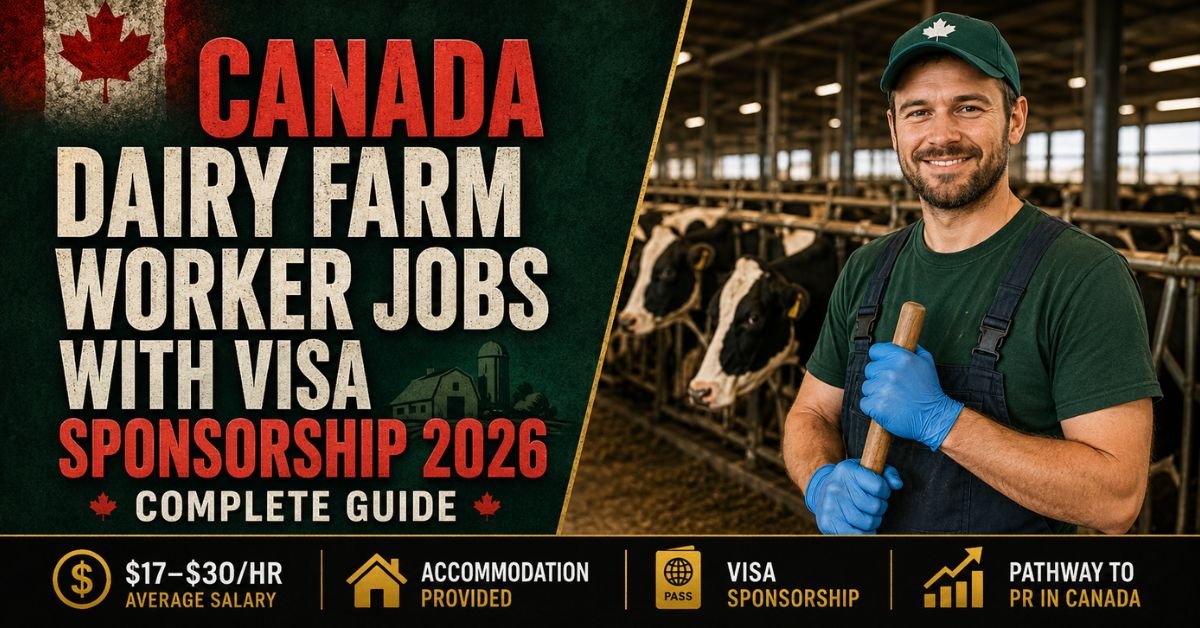
The dairy industry of Canada has been facing a major shortage of farm workers, which is why dairy farm jobs with visa sponsorship are becoming popular among people looking for agricultural work in Canada in 2026. One of the biggest advantages is that you usually don’t need a university degree for dairy farm worker jobs in Canada in 2026. Many jobs offer good pay, and if you find an employer who is willing to sponsor you, you may be able to get a Canadian work permit. In some cases, this experience can also help you work toward permanent residency in Canada. So if you want to build your career in dairy farming in Canada, then this is a great opportunity for you.
However, you need to be very careful; always cross-check. Many fake job offers and scams exist in the whole world, especially those targeting workers from developing countries. Some people may ask you for large amounts of money or promise a guaranteed Canadian visa or job, but that is not true. Be aware of these types of scams. Never give money for any job.
That’s why it’s important to understand how the real process works. In this guide, we’ll explain the Temporary Foreign Worker Program (TFWP), Agricultural Stream, and Labour Market Impact Assessment (LMIA) in simple words, and also explain how to apply for this job. You can understand how legitimate dairy farm jobs in Canada work and avoid scams.
Why Dairy Farm Jobs in Canada Are in Demand
Provinces such as Manitoba, Ontario, Alberta, and Quebec run large dairy operations that need year-round labour: feeding, milking, herd health monitoring, and barn maintenance don’t stop for a labour shortage. Under Canada’s National Commodity List, bovine and dairy production is an eligible commodity sector for hiring temporary foreign workers, which is why dairy farms are consistently among the most active employers using the Agricultural Stream.
Because the role is classified as general farm labour or herdsperson work (NOC codes in the 8431/8432/85100 range), it typically doesn’t require a degree, making it genuinely accessible to entry-level candidates, though physical stamina and reliability matter enormously.
How Visa Sponsorship Actually Works for Farm Workers
“Visa sponsorship” for a Canadian farm job almost always runs through the Temporary Foreign Worker Program (TFWP) Agricultural Stream, not a special “farm visa.” Here’s the real sequence:
- A Canadian employer tries to hire locally first. As of April 2026, employers must show genuine recruitment effort before applying for a foreign worker.
- The employer applies for a Labour Market Impact Assessment (LMIA) through Employment and Social Development Canada (ESDC), proving that hiring a foreign worker won’t negatively affect the Canadian labour market. For primary agriculture NOC codes, the LMIA processing fee is actually waived.
- Service Canada issues a positive LMIA, valid for up to six months, confirming the wage, job duties, and working conditions offered.
- The worker uses that LMIA and job offer to apply for an employer-specific work permit through IRCC, then completes biometrics and (where required) a medical exam.
- Under the Agricultural Stream, work permits can be valid for up to 24 months, and the stream is exempt from the low-wage processing freeze that affects other sectors.
A few things worth knowing that a lot of listicle articles leave out:
- Employers must pay your round-trip transportation costs to and from Canada; this cannot legally be charged to you.
- No recruitment fees may be charged to the worker, directly or indirectly. A legitimate employer or licensed recruiter never asks you to pay for a job offer or LMIA.
- On-farm housing must meet federal inspection standards, and if housing is deducted from pay, there’s a legal cap (roughly $30/week on-farm, pro-rated); it isn’t an unlimited deduction.
Typical Job Responsibilities
Daily duties on a Canadian dairy operation generally include:
- Feeding and monitoring cattle
- Operating milking equipment (parlour or robotic systems, depending on the farm)
- Cleaning barns, pens, and equipment to hygiene standards
- Assisting with calving, breeding, and basic animal health checks
- General farm machinery use and maintenance
Expect early starts, weekend rotations, and physically demanding work in both indoor and outdoor conditions. This is real livestock labour, not light farm-adjacent office work.
Salary and Working Hours: What’s Realistic
Wages vary by province, employer, and experience, but general farm workers and dairy herdspersons in Canada commonly earn in the CAD 17–30/hour range, with prevailing wage rates set by each province’s Job Bank wage data (employers under the Agricultural Stream must match or exceed the prevailing wage for the occupation and region. This protects both Canadian and foreign workers from being underpaid).
- Weekly hours: commonly 40–60 hours, including overtime during calving or peak season
- Employment type: many Agricultural Stream jobs are full-time and can be structured as long-term or permanent
- Overtime: governed by provincial employment standards; always confirm your province’s rules before accepting a contract
Be cautious of listings advertising unusually high flat rates (e.g., “25–30/hour guaranteed, no experience, instant approval”) with no employer verification. Always check the wage against your province’s official Job Bank prevailing wage for the same NOC code before trusting a number.
Eligibility Requirements
You generally need to be able to show:
- Physical fitness for repetitive, demanding labour
- Willingness to relocate and adapt to rural life
- Basic functional English or French for workplace safety instructions
- A genuine, verifiable job offer from a Canadian employer (this is the foundation of the entire process; everything else follows from it)
Prior farm or livestock experience is an asset and improves your competitiveness, but it is often listed as “not mandatory” for general labourer roles; experience becomes more important for herdsperson or equipment-operator positions, which also tend to pay more.
Step-by-Step: How to Apply
We can explain to you how to apply for dairy farm worker jobs in Canada in 2026. Here is a step-by-step guide:
- Prepare your documents: Passport, resume focused on physical/farm work history, references, and proof of language ability if requested.
- Search only verified sources: Canada’s official Job Bank (jobbank.gc.ca), licensed immigration consultants (check the ICCRC/CICC register), or the direct careers page of a named, verifiable farm.
- Apply with a tailored resume and cover letter highlighting reliability, physical stamina, and any animal-care or agricultural background.
- Attend the interview: Usually by phone or video; expect questions about availability, ability to relocate, and comfort with the work schedule.
- Employer initiates the LMIA application once they extend a job offer.
- Apply for your work permit using the positive LMIA and job offer letter, then complete biometrics and any required medical exam.
- Travel to Canada once your work permit is approved and start your role.
Benefits of These Roles
- Low barrier to entry: No degree required for general labourer positions
- Competitive wages relative to many source-country labour markets
- Housing support on many farms, which meaningfully reduces cost of living
- Experience that counts toward future opportunities, including supervisory farm roles
- A potential pathway to permanent residency through routes like Provincial Nominee Programs (PNPs) or the Canadian Experience Class, after gaining qualifying Canadian work experience, though this is not automatic or guaranteed and depends on the specific program’s criteria at the time you apply
How to Spot and Avoid Scams
This is the part that matters most, because agricultural visa-sponsorship listings are a favourite target for fraud. Red flags include:
- Being asked to pay a fee for a job offer, LMIA, or “processing”; legitimate employers and the LMIA process never charge the worker
- Vague or unverifiable employer details: A real employer will have a findable business registration and, ideally, a listing on Job Bank
- Guaranteed visa approval: No legitimate recruiter or employer can guarantee a work permit; IRCC makes that decision independently
- Pressure to decide or pay quickly: Legitimate hiring timelines involve LMIA processing (often 30–60+ business days) and work permit processing on top of that
If in doubt, verify any Canadian employer directly through Job Bank or a licensed Canadian immigration consultant before sending money or personal documents.
Also Read: Fruit Farm Worker Jobs Australia 2026: Complete Career Guide to a Full-Time NT Opportunity
Frequently Asked Questions
Do I need experience for dairy farm jobs in Canada?
Not always — general labourer roles are often open to first-time applicants, though experience improves your chances and pay for specialized roles like herdsperson or equipment operator.
Is visa sponsorship guaranteed once I get a job offer?
No. A job offer allows an employer to apply for an LMIA, and a positive LMIA allows you to apply for a work permit — but IRCC makes the final decision on your application.
Can I bring my family?
In some cases, depending on your specific work permit conditions and the length of your contract — check current IRCC rules for your permit type before assuming this is included.
Is there an age limit?
There’s no fixed maximum age for these roles, but physical capability for the work is a practical requirement.
Is accommodation always provided?
Many Agricultural Stream employers do provide or arrange housing (a program requirement in several cases), but terms — free vs. wage-deducted — vary by employer, so confirm this in writing before accepting an offer.
Final Takeaway
Canada’s dairy farm jobs with visa sponsorship are a real option in 2026. However, you must follow the proper TFWP Agricultural Stream and LMIA process. There are no guaranteed shortcuts.
Always check the employer carefully and never pay someone to get you a job offer. Don’t trust anyone who demands the highest pay. Also, make sure the salary matches the official wage for that type of job.
If you follow the correct process and find a genuine employer, dairy farm work can be a good way for you to get stable work in Canada in 2026, even if you don’t have a university or college degree. Share it with someone who is dreaming of a dairy farm worker job in Canada in 2026.
Disclaimer: This article is for informational purposes only and does not constitute immigration or legal advice. Job details are based on publicly advertised information and may change — confirm directly with the employer.
1 thought on “Canada Dairy Farm Worker Jobs With Visa Sponsorship 2026: Complete Guide”