The job market has changed; the salary for the jobs has become much lower than average. The high paying job require a pretty educational qualification. For the skilled worker who has lack of formal degrees face difficulties finding suitable career options.
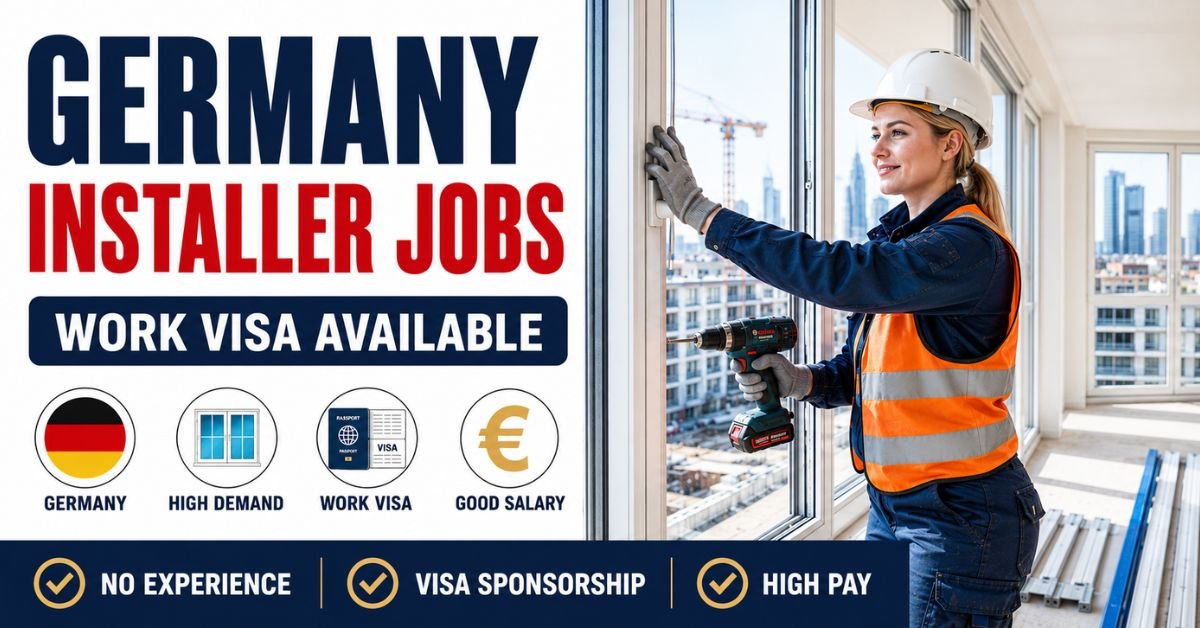
Windows and Door installer jobs in Germany are worthy career options. It does not demand any high educational qualifications except for administrative job roles. For window and door installer jobs, payment is also reasonable. The windows installer or interior finisher is trending in job market and is the most sought-after job by foreign workers.
There are thousands of job roles available in the market, but some of them are temporary naturally. On the other hand, job roles like this are said to be evergreen due to high construction work across the world. Whether it is Asia or Europe, even the Middle East, houses and offices are being built. So this requires workers for interior work like installing doors and windows, etc.
Why Window and Door Installers Are in Demand in Germany
Germany’s skilled-trades sector has a well-documented labor shortage. The Federal Employment Agency (Bundesagentur für Arbeit) and Handwerkskammer (Chambers of Skilled Crafts) have both flagged construction finishing trades — drywall, interior carpentry, window and door fitting (Fensterbauer, Tischler) — as shortage occupations in several regions, including North Rhine-Westphalia, where Dortmund is located. That shortage is real, and it’s why relocation-friendly offers — subsidized housing, no language requirement, above-average pay — genuinely exist. It’s also why it pays to confirm the specifics of any individual listing rather than assume every ad in this space is identical.
What the Job Actually Involves
Job titles in this space are often broader than the day-to-day work. “Window installer” postings frequently center on:
- Installing interior doors, frames, casings, and jambs
- Cutting flooring and drywall to fit door openings
- Mounting handrails and stair railings
- Sealing joints, installing insulation
- Facade and exterior sheet-metal work, sometimes from scaffolding or lifts
- Checking (not installing) window function in some interior-finishing-heavy roles
If a listing’s title and its task list don’t match — e.g., “Window Installer” but the duties are 90% drywall and railings — that’s not automatically a scam, but it’s worth clarifying directly with the employer before relocating.
Legitimate Pathways for Foreign Tradespeople
For EU/EEA citizens
Freedom of movement means no work visa is needed. The main things to verify are the employer’s legitimacy and the contract terms (see red flags below).
For non-EU citizens
Germany does have real, structured routes into skilled trades:
- Chancenkarte (Opportunity Card) — a points-based visa allowing qualified workers to enter Germany and job-search for up to a year, based on qualifications, language skills, age, and work experience.
- EU Blue Card / Skilled Worker visa — for those with a recognized vocational qualification and a concrete job offer.
- Vocational qualification recognition — many trades require your qualification to be assessed as equivalent to a German standard (via the “Anerkennung” process at anerkennung-in-deutschland.de).
Verified job sources
- EURES (the EU’s official job mobility portal) — lists real, vetted vacancies from registered employers.
- Make it in Germany — the German government’s official portal for skilled migration, including construction trades.
- Regional Handwerkskammer job boards — chamber-affiliated postings are tied to registered businesses.
Compare any private listing against what you find on these platforms. If a “too good to be true” offer never appears on any official channel, treat that as a signal, not a coincidence.
What to Check Before You Commit to a Listing
Whenever you encounter any portal or network about a career option. Before sharing any personal or professional details, including passport or CV, check these listed points:
- Is there a verifiable company name? “A construction company in Dortmund” isn’t an employer — it’s an anonymized placeholder. A named employer can be checked in the German commercial register (Handelsregister).
- Is there a real application channel? Look for an actual link, email, or named contact, not just “apply through the official listing.”
- Are you being asked to pay anything upfront? Fronting money for boots, clothing, or “processing”, even with a promised reimbursement later — is worth clarifying carefully; reputable German employers typically don’t require this.
- How is housing structured? Legitimate accommodation arrangements exist, but it’s worth understanding whether housing is optional or mandatory, and how it’s tied to your pay and your ability to leave the job if needed.
- Does the ad meet German hiring-law standards? Under Germany’s Allgemeines Gleichbehandlungsgesetz (AGG), job ads generally cannot specify gender or a narrow age range as hiring criteria. A listing stating “men, 22–55” is unusual and worth asking the employer about directly.
- Is there pressure to decide quickly? “Only 3 spots,” “don’t wait”: a genuine opportunity can usually withstand a few days of due diligence.
- Can the numbers be verified? Look for a written contract, payslip example, or other documentation behind figures like hourly wage or reimbursement amounts, rather than taking a listing’s claims at face value.
Working through this list takes an hour, and it’s the difference between an informed decision and a leap of faith.
How to Confirm a Listing Is What It Says It Is
- Search the company name in the German Handelsregister (handelsregister.de) to confirm it’s a registered business.
- Cross-check the vacancy on EURES or Make it in Germany; genuine shortage-occupation roles are often cross-posted there.
- Ask for a written contract (Arbeitsvertrag) before travel. German employment contracts must specify wage, hours, and job description in writing.
- Contact the local Handwerkskammer for the region the job is in; they can often confirm whether a company is a registered trade employer.
- Be cautious of any upfront payment requested for a job, visa processing, or placement; legitimate employers and government visa routes generally don’t charge candidates placement fees.
Realistic Salary and Working Conditions
For context, entry-to-mid-level interior finishing and window/door trade roles in Germany typically fall in the range of gross hourly wages set by regional collective agreements (Tarifvertrag) for the construction sector, which are publicly listed by IG BAU (the construction workers’ union) and the Bundesagentur für Arbeit’s wage database. Comparing any offer against these published rates is one of the fastest ways to tell if a number is realistic or inflated to look attractive.
Also Read: How to Introduce Yourself in a Job Interview: A Complete Guide
Standard German construction schedules commonly run five days a week with defined hour limits under the Arbeitszeitgesetz (Working Hours Act); consistent 10-hour days should be reflected explicitly in the contract, with any overtime pay terms spelled out — not left implied.
FAQs
Do I need to speak German to work in construction trades in Germany?
Not always for hands-on roles, but basic workplace German is a major practical advantage for safety instructions, contracts, and daily coordination. And its absence in a job requirement isn’t itself a red flag.
Is housing at a flat low rate normal?
Some legitimate employers do offer subsidized housing, but the terms should be in writing, optional or clearly explained, and not used as the only way to secure the job.
What should I do if a listing’s details don’t check out?
Hold off on sending documents or money until you can confirm the employer and terms. You can raise concerns about a questionable job ad with the Bundesagentur für Arbeit or the platform where you found the listing.
Are there real “no language required” trade jobs in Germany?
Yes, shortage occupations in construction finishing genuinely exist, but they’re best found through EURES, Make it in Germany, or Handwerkskammer boards, where the employer is identifiable and accountable.
Bottom Line
The demand for interior finishers, drywallers, and window/door installers in Germany is real, and so are the legal pathways to fill those roles; for both EU and non-EU workers. But the more specific and generous an anonymous listing sounds, the more it’s worth verifying the employer independently before you commit, travel, or spend a euro. Use official channels first; treat everything else as a lead to verify, not an offer to accept.