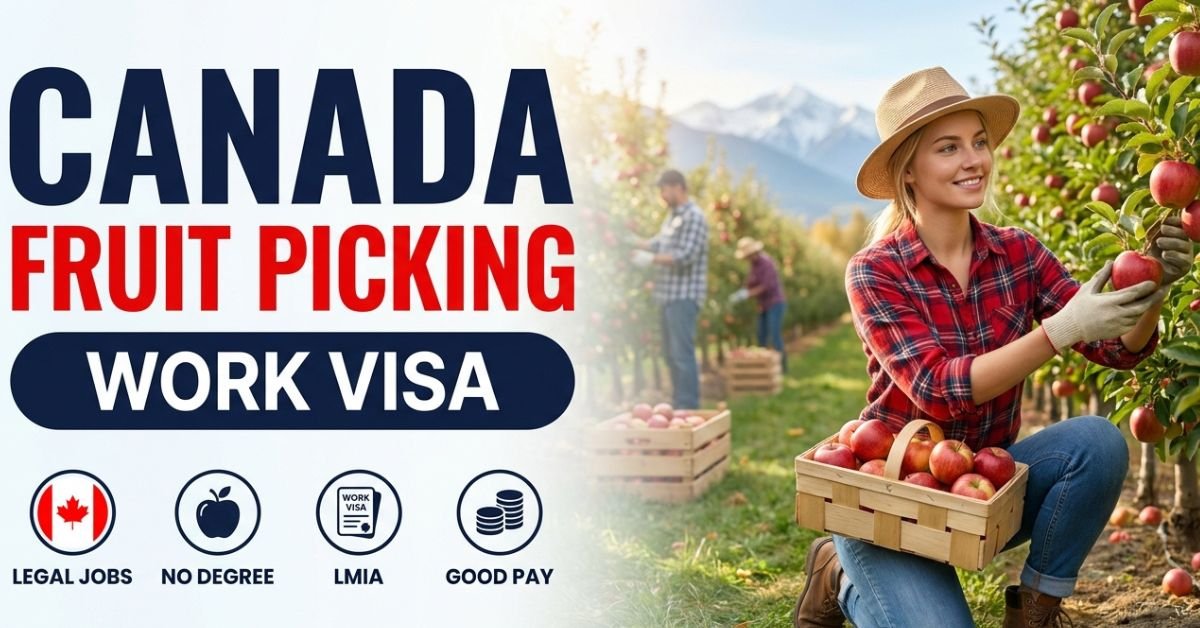
Fruit picking jobs in Canada are the most searched career option by people who do not have a high educational qualification. Thousands of people every year try to find ways to get into Canada without any university degree, high experience, or any high investment. Because fruit picking is a genuine career door out of a few that demands basic requirements.
As thousands of people try to grab the fruit picking jobs in Canada, they fail on a large scale to secure the job. Because they do not fully comply with requirements. Fruit picking is physical work with a legitimate path to get a legal work permit.
To work in Canada in a legitimate way, a valid work permit, a Canadian paycheck, and long-term future are the basic steps. To be eligible to work in Canada, an individual has to meet criteria that are helpful in getting a legal career option in Canada.
This guide is designed to provide what a beginner exactly needs to qualify for the fruit picking jobs in Canada. It breaks down what the requirements are, how to apply for a job, and what the expected pay is for the role.
Why Fruit Picking Jobs in Canada Are Recommended
Canada is involved in the huge production of fruits. The fruit industry in Ontario and Nova Scotia contains cherries and grapes that depend heavily on labour in seasons. Farms contritubute in fullfilling the demands to struggle in filling the vacant roles, which is why the federal government brings in foreign workers to fill the gap in order to maintain dedicated programs.
These fruit farms often face a labour shortage; if someone looking for fruit-picking jobs in Canada tries to apply and find a serious recruiter, then it can be said to be the best approach. The labour shortage is an entry point to the program that is backed up by the federal government; it means government recognized hiring pathway exists other than economy promises.
Fruit Jobs in Canada are recommeded beacuse these offer suitable pay for working on farms. The basic job requirements are pretty simple and do not require any high educational qualifications for basic roles. When farms face a labour shortage that is seasonal so then it becomes easy for job seekers to get into farms and secure fruit picking roles easily.
One more reason for the recommendation for the fruit picking jobs in Canada is that to fill the gaps of labour shortage, the federal government contributes to filling the seasonal gaps.
Basic Job Requirements for Fruit Pickers in Canada
Fruit picking jobs come with numerous job roles, and each one has its complex or simple criteria. For the basic job roles in Canada, the requirements are given below, including physical health requirements, experience, education, and language as well as age requirements.
Before getting in touch with paperwork it is best approach for the job seeker to examine whether they actually fit or meet the job requirements or not.
1. Physical health
This is the most basic and necessary requirement across all roles in fruit picking farms. Physical health is given more attention because the worker has to stay on feet for more than 8 hours a day. The weather conditions may change daily.
While working in fruit farms, whether it is fruit picking or any other work, workers have to lift up to 23 kg. This weight could be in the form of fruit in crates or bags. Physical factor is the basic requirement that most workers cannot qualify for.
2. Experience
Most of the hiring shows “no experince nessary/ required, they indirectly show that on-site training might happen. As already discussed, the fruit farms jobs are not limited to just one role, so maybe the applicant with prior experience would be directed to the orchards that prefer experienced workers.
Experience is not considered mandatory for all roles; if the applicant has no experience, there could be training centers. But if the applicant mentions the experience they have had, then it can shorten the training/learning curve.
3. Education
Education is the necessary requirement for almost every job for foreigners. A fruit-picking job in Canada is classified under Canada’s National Occupational Classification as working as a foreginer do nto requrie formal education, but some short term on the job traning guidelines are taught.
It is confirmed by the official Canada Occupational Classification that roles like fruit picking require no formal education; these are short-term work. If any worker has a high school diploma, then it is an extra perk, but it is never said to be a requirement.
4. Language
In the basic requirements for working in fruit farms in Canada, language is a main factor. To work as a fruit picker in the farms of Canada, foreign workers do not need an IELTS score to work. Basic conversational English or French is required; that is helpful for instructions and dealing with crew.
There is no official announcement about the need of formal language for basic roles like fruit picking. It may be required for high administrators and managerial roles. So generally for fruit picking roles, conversational English or French should be.
5. Age
Age is a mandatory factor when it comes to working in foreign countries. Due to labour rules, the worker should be 18 years or older. Similarly, to work on a farm, the worker should be at least 18 years old. Otherwise might fail to join the fruit farms if their age is below 18.
Legal and Visa Requirements: What You Actually Need to Work Legally
1. A Job Offer from a Canadian Farm
You cannot apply for a work permit on spec. You need a genuine job offer from a Canadian employer first — typically a farm that’s registered to hire under the Temporary Foreign Worker Program (TFWP), or in some cases the Seasonal Agricultural Worker Program (SAWP), a sub-stream specifically for agricultural work.
2. A Positive LMIA (Labour Market Impact Assessment)
Once you have an offer, your employer not you applies for an LMIA. This is a document Employment and Social Development Canada issues to confirm that hiring a foreign worker won’t take a job away from a Canadian citizen or permanent resident, essentially proving there was no qualified local candidate available.
Employers who go through this process must also commit to paying wages at or above the local market rate and providing safe working conditions.
Without a positive LMIA in hand, you cannot move to the next step.
3. Apply for Your Work Permit
With the job offer and LMIA secured, you submit your work permit application through Immigration, Refugees and Citizenship Canada (IRCC). This involves:
- Completing the online or paper application
- Submitting personal and employment documentation
- Paying the required processing fee
- Providing biometrics (fingerprints and a photo) at a visa application centre
4. Background and Health Checks
- A clean criminal record check
- A medical exam from an approved panel physician
- A valid passport (typically valid for at least six months beyond your planned stay)
5. Wait for Approval and Prepare to Travel
Processing times vary by country and season. Because harvest season is time-sensitive, most immigration advisors recommend applying at least three to four months before your intended start date, peak hiring for spring and summer harvest positions typically runs from January through April.
How Much Do Fruit Pickers Earn in Canada?
Pay depends on province, crop, and whether you’re paid hourly or by volume picked (piece-rate). Based on current job postings and government labour market data, most fruit picking roles pay in the CAD $15–$20 per hour range, with some general farm labour roles reaching CAD $16–$22 per hour depending on the province and task complexity.
British Columbia’s WorkBC data pegs average annual earnings for harvesting labourers in the province at roughly $28,972 a year, though this includes part-time and seasonal patterns rather than year-round full-time work.
Some employers offer additional benefits on top of base pay:
- Subsidized or free on-site accommodation
- Transportation to and from the farm
- End-of-season bonuses tied to attendance or productivity
Top Provinces for Fruit Picking Work
| Province | Common Crops | Notes |
|---|---|---|
| British Columbia | Cherries, apples, grapes, blueberries | Okanagan Valley is the hub; some farms offer paid accommodation |
| Ontario | Apples, peaches, strawberries | Large concentration of SAWP-approved farms |
| Quebec | Blueberries, apples, strawberries | French language ability is a plus |
| Nova Scotia | Apples | Smaller farms, often family-run |
| New Brunswick | Blueberries, apples | Growing seasonal demand |
How to Find Legitimate Fruit Picking Jobs in Canada
To find a reliable and suitable platform for fruit picking jobs in Canada is the main challenge. Sometimes applications are sent, but they do not respond. It is always better to find a serious employer, so for this worker should stick with verifiable sources:
- Canada Job Bank: search under NOC code 85101 (Harvesting labourers) for verified, government-listed postings from employers approved to hire internationally.
- Provincial fruit grower associations: groups like the BC Fruit Growers’ Association or BC Cherry Association list openings directly from member farms.
- Direct farm websites: many larger operations post seasonal openings and application instructions directly.
- TFWP-registered recruiters: verify any recruiter or agency against IRCC’s list of authorized representatives before paying any fee. Legitimate employers do not charge you for a job offer.
Also Read: Window and Door Installer Jobs in Germany: Full Guide 2026
Frequently Asked Questions
Do I need a college degree to pick fruit in Canada?
No. Harvesting roles are classified as requiring no formal education — only short-term, on-the-job training.
Can I apply without any farm experience?
Yes. Most listings state “will train,” though prior farm or physical labour experience can strengthen your application.
How long does the work permit process take?
It varies by country of origin and season, but applying three to four months ahead of your intended start date is the standard recommendation.
Is fruit picking a path to Canadian permanent residency?
Not directly, but time spent working legally in Canada under a valid work permit can sometimes count toward eligibility for other immigration programs later. This depends heavily on individual circumstances, an immigration consultant can advise on specific path.
Final Thoughts
Fruit picking jobs in Canada are one of the most accessible legal work opportunities for people without formal qualifications, but “accessible” doesn’t mean “unregulated.”
You’ll need a real job offer, a positive LMIA from your employer, and a properly filed work permit application through IRCC. Skip any of those steps, or trust anyone who says you can skip them for a fee, and you’re looking at a scam rather than a job.
Disclaimer: This article is for informational purposes only. Job openings, salaries, and visa requirements may change. Please verify details with official Canadian government and employer sources before applying.