Choosing a career option is the step everyone goes through. To reach the goal, job seekers go through different scenarios; one of them is job interview. A job interview is a step in the hiring process that can make a well qualifieed candidate feel nervous. Most of the poeple can crack the job interview without getting nervous and secure the spot.
If a candidate has the right skills, strong experience, and a history of good results, they are noticed to be confident during the interview. But most of the people still try to express themselves clearly in the interview, because the interview creates pressure.
During interviews, the candidates are expected to answer unexpected questions, demonstrate confidence, and summarize personal and professional values in a limited amount of time. During this session, while the interviewee answers the question or introduce the hiring manager notices everything from verbal communication to facial expressions. This helps in evaluating whether the candidate is suitable for the job role or is to be skipped.
Being confident during interviews is a skill, and no one is born with it. This skill can be developed to the next level with the help of preparation, practice, and understanding the procedure of how interview works.
In this guide, 5 tips will help in improving body language, making a convincing impression, and preparing for handling difficult questions with stronger answers.
1. Remember Your Value Before the Interview
The most important thing during an interview is to communicate clearly and answer honestly without trying to manipulate or impress the interviewer excessively. Many candidates feel they must constantly prove that they deserve the employer’s attention. However, this mindset can create unnecessary pressure, causing them to overthink their answers, communicate their achievements poorly, and become afraid of saying the wrong thing.

The company reviews the resume along with experience, qualifications, and portfolio, etc. The hiring team can start the conversation with the relevant background achievements. When an interview goes through these documents, the job is currently secured, but these certificates are not enough to show the potential to the interviewer. However, the interviews are designed to explore the candidate in more and more detail.
So, before the interview starts, try to remind yourself of all the previous roles, values, and the problems you solved. Recall the moments where the teams you supported and the projects that were completed merely by you or with your contribution.
Due to technical expertise, leadership, critical thinking ability, and problem solving skills, your value may be increased. Real evidence is considered more authoritative than statements like “I am confident”. Then interview’s answers are on fact based then the confidence becomes stronger.
Similarly, remember your value before the interview and recall all projects in which you have contributed. This shows expertise and acts as evidence of potential.
2. Use the Power of Persuasion
A job interview is an analysis done by the interviewer that covers and examines every aspect of the candidate. It is not just a question-and-answer session, but it is a professional-level conversation that helps in influencing the manager. Along with answers and questions, it is a way that helps the interviewer evaluate the skills candiate got and whether they are relevant to the company’s needs or not.

The most common mistake seen among candidates is that they only focus on revealing the responsibilities. As an example, “I managed customer support”. A strong response should involve how you handled challenges and what progress happened due to your actions. Tailor a strong and reliable response instead of generic one.
Normally, persuasive interviews contain a clear claim, supporting evidence, and relevance to the role. By good communication skills, a candidate can make claims and support them with specific examples and finally connect the experience to the relevant position.
3. Frame Every Answer Before Giving the Details
As interviews start following a pattern like introduction, then question-answer sessions. So, the common mistake is to jump directly to the middle of the story. Always try to present ideas in a clear way so that the interviewer can understand easily. Because the topics you discuss do not have any contextual existence in the interviewer’s mind. This can result in an incomplete or confusing session.

Don’t rush to explain what you did; follow a brief stage. Describe where you had work and what your responsibilities were. Everything you highlight during the interview must have a connection to the current situation.
The STAR interview method is useful for behavioral interview questions. STAR stands for Situation, Task, Action, and Result. First, explain the situation. Next, describe the task or responsibility you had. Then explain the specific actions you took. Finally, share the result and what you learned.
The second answer gives the interviewer enough context to understand the challenge and evaluate the candidate’s contribution.
4. Keep Extra Stories in Your Back Pocket
Many candidates prepare answers to common questions but still freeze when the interviewer uses different wording. The solution is not to memorize dozens of complete answers. Instead, prepare a small collection of flexible stories that can be adapted to different questions and make sense in the context of the role.

You should have at least three or four strong examples covering important skills such as leadership, technical expertise, communication, teamwork, adaptability, and problem-solving. Each story should include the situation, your responsibility, your actions, the final result, and the lesson you learned.
5. Visualize Success and Strengthen Your Body Language
In the days leading up to the interview, spend five minutes each day visualizing the conversation going well. Picture yourself entering the room or joining the video call calmly. Imagine greeting the interviewer professionally, listening carefully, answering questions clearly, and recovering smoothly if you receive a difficult question.
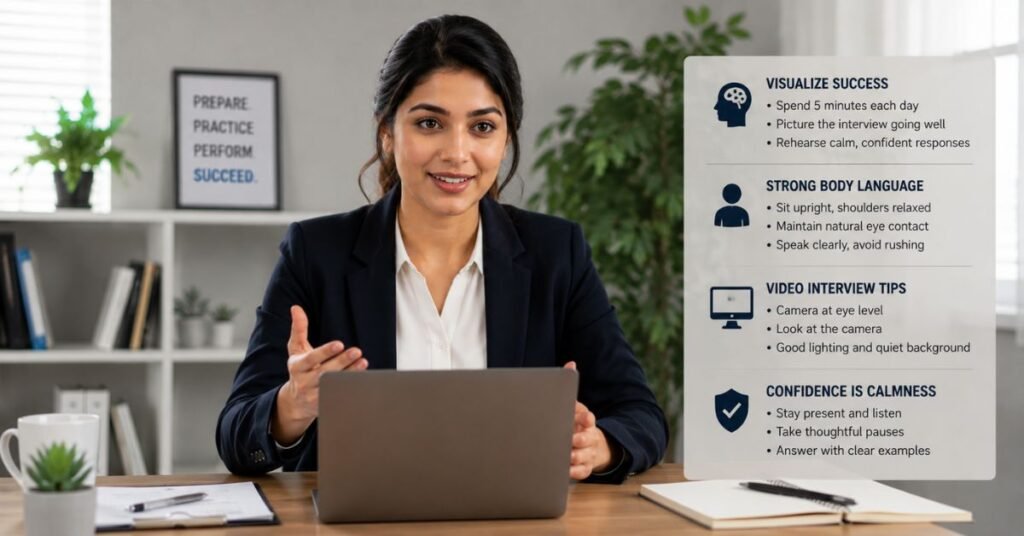
Visualization is not about imagining a perfect performance. Its purpose is to make confident behavior feel more familiar. When your mind has already rehearsed the situation, the actual interview may feel less threatening and unpredictable.
Body language also plays an important role in interview confidence. Sit upright without becoming stiff, keep your shoulders relaxed, and maintain natural eye contact. Avoid speaking too quickly or filling every pause with unnecessary words. A short pause can make you appear thoughtful and composed.
During a video interview, place the camera close to eye level and look toward it regularly instead of watching your own image throughout the conversation. Make sure the room is quiet, your face is well lit, and your background is not distracting.
Confidence is often communicated through calmness rather than constant enthusiasm. You do not need to smile during every answer or speak loudly. Focus on being present, listening carefully, and responding with clear examples.
How to Answer “Tell Me About Yourself”
One of the most common interview questions is “Tell me about yourself.” The interviewer is not asking for your entire personal history. They want a focused professional introduction that explains what you do, what relevant experience you have, and why you are interested in the role.

A strong answer can follow the present-past-future structure. Start with your current professional position, briefly mention relevant past achievements, and finish by explaining why the opportunity interests you.
Keep your answer relevant and avoid discussing unrelated personal details unless they support your professional story.
Also Read: What Are the Requirements for a Janitor Job in the USA? Your 2026 Career Guide
Final Thoughts
Interview confidence does not come from pretending to be fearless. It comes from preparation, self awareness, and evidence. Remember why you were invited, understand your professional value, prepare flexible stories, and practice explaining your experience clearly.
Be confident during the interview and stay relevant to the situation. Focus on providing clear and easy to understand responses.